


The work day was over. The house was quiet and I had some privacy. I dimmed the lights in my office and fired up “the video”. I watched intently as the content covered nipple wrenches, dry balling, lube, touch holes, and ball pullers. By the end, I was ready to try something new: Shooting a traditional muzzle loader. What did you think I was talking about!?
Pennsylvania is a bit unique in that we have a late deer season solely for primitive firearms. Specifically flintlock muzzle loaders. If you aren’t familiar with muzzle loaders, a brief history is in order.
Going back to the earliest of firearms, the function was essentially similar to a modern era muzzle loader. A black powder charge was dumped into the barrel followed by a projectile. At the user end of the gun, a small powder charge would be ignited by an ignition source initiating a reaction through a flash hole in the barrel. This would ignite the main powder charge, launching the projectile in the general direction of the man, beast or target one was attempting to demolish. The only thing that has changed through the ages is the ignition source.
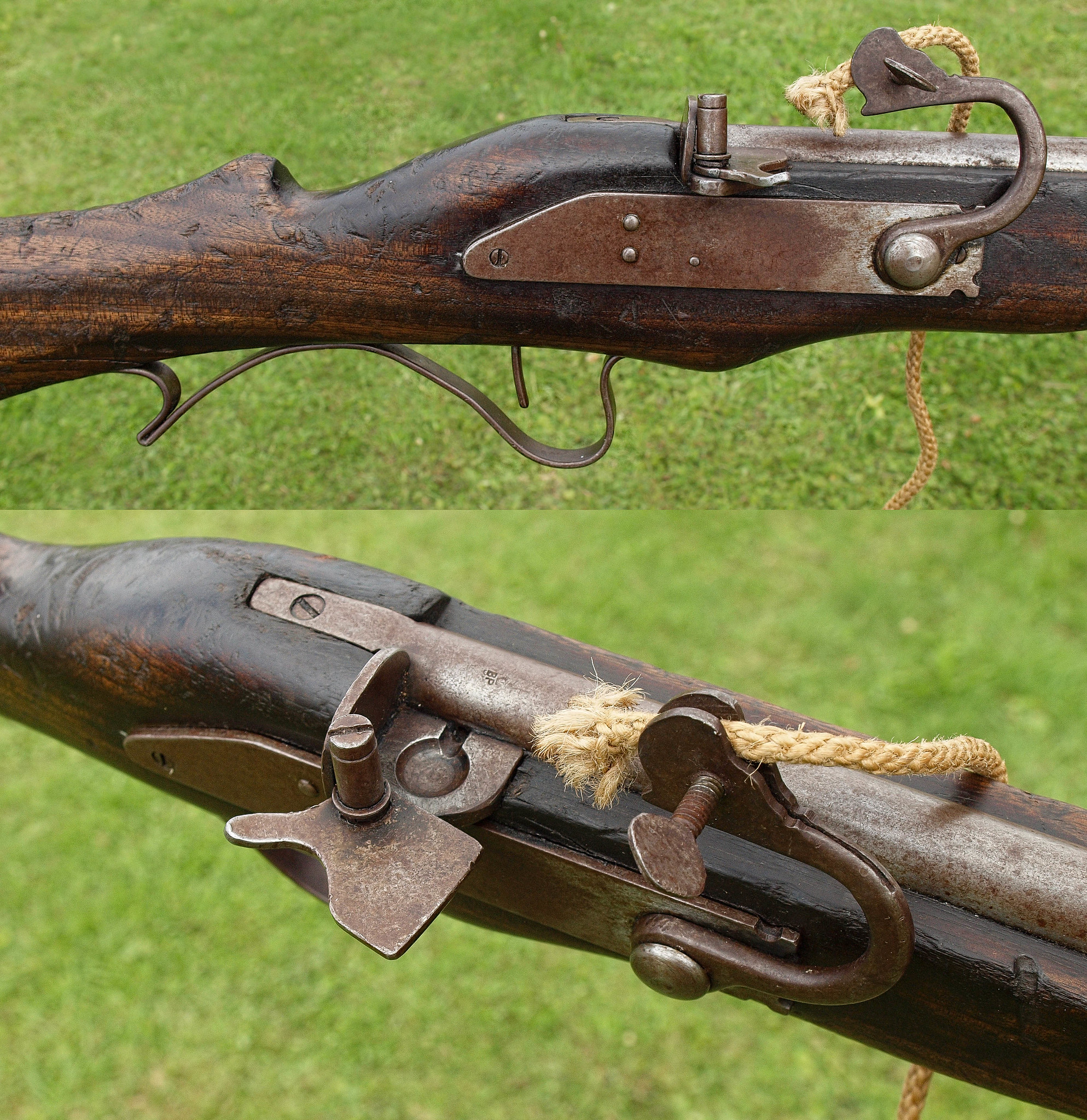
The very first firearms were known as match locks. (Not the little toy cars . . that’s match box.) A match lock featured a smoldering fuse that was held by a hammer of sorts and suspended above a covered pan with a small charge of powder. When the trigger was pulled, the smoldering match would be jammed into the powder charge via an opening in the cover. This would ignite the charge in the pan and subsequently, the firearm. At least that’s the way it worked in theory. The user had to be constantly aware of the condition and length of the fuse. Also, the user had to restrict going into battle or hunting nice weather as the fuse was unlikely to burn in the rain.
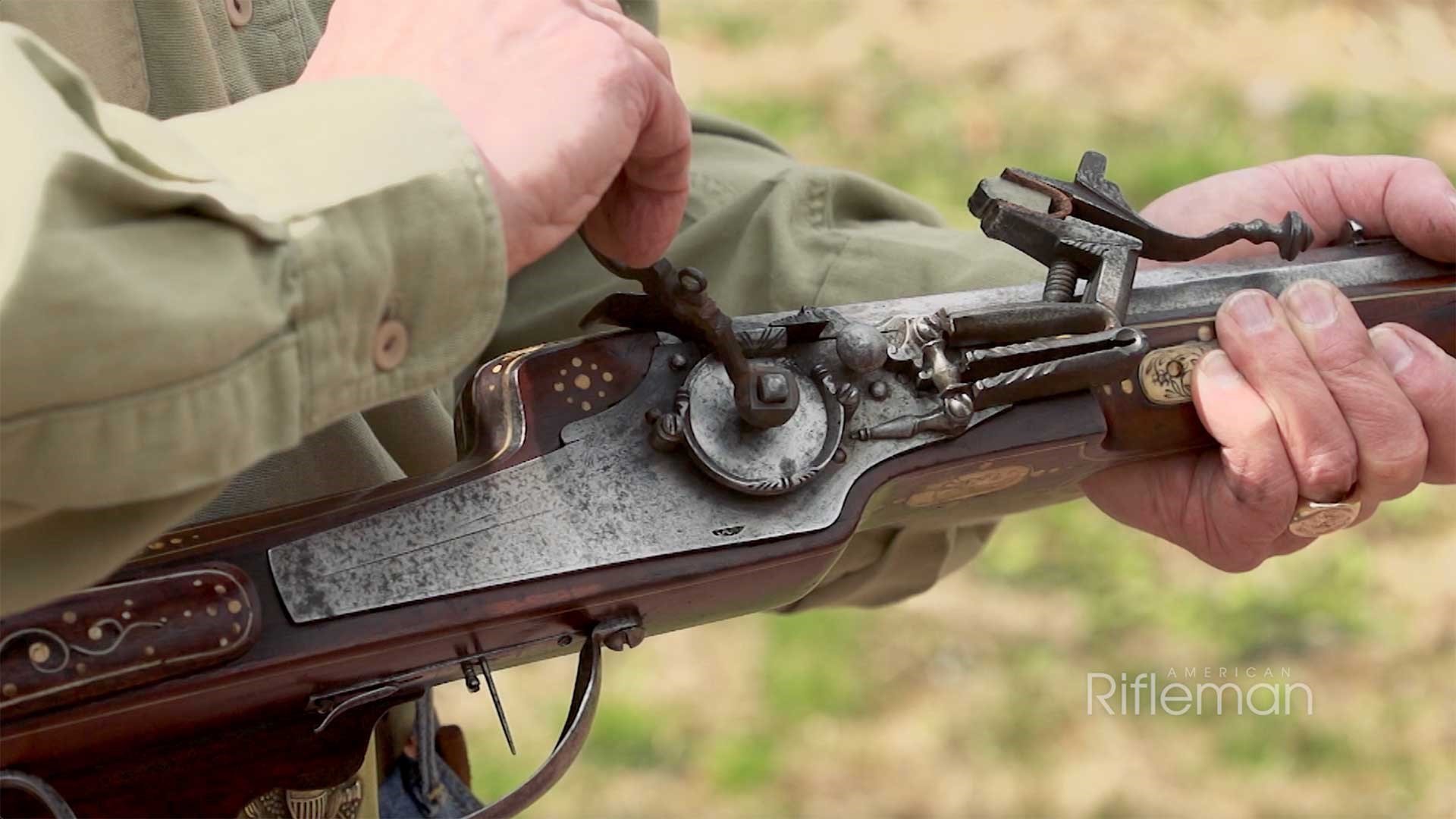
Eventually some frustrated member of Europe’s upper class must have missed a chance at a big buck when his match went out, and the wheel lock was subsequently invented. The wheel lock used a spinning piece of steel against iron pyrite to generate sparks and ignite the powder in the pan. The wheel lock was fairly ingenious for its time. It was a significant improvement over the match lock, but not without its downsides. Mostly it was a complicated and expensive device that required both gun smithing and clock making skills to build or fix. As such, the wheel lock saw very little use by the military and was used only by the most affluent of society.
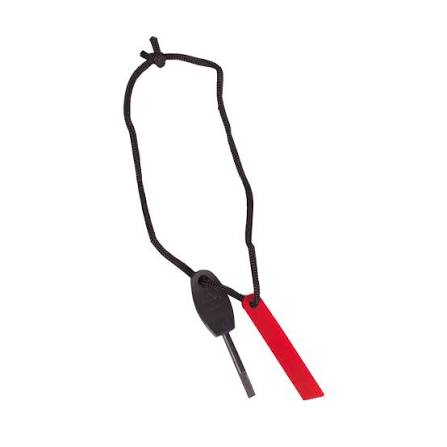
The next progression was the flintlock. Technically the snaphaunce came first but it was essentially a prototype flint lock. This history lesson probably already has you falling asleep and thinking about cat videos on YouTube so we’ll dispense with the subtle differences and just discuss the flint lock. A flintlock uses a piece of carefully knapped flint held tightly in jaws at the end of the hammer. When the hammer falls, the flint strikes a metal piece called the frizzen creating sparks that get driven into the powder charge in the pan. You should be picturing your days in the scouts where you learned to start a fire with a flint and steel. I always found this ironic for an outfit that chanted “Be prepared!”. I mean, if I can remember to pack a flint and steel, I’m just as likely to remember some matches or a Zippo lighter. Anyway . . where was I? Oh right. The Flintlock.

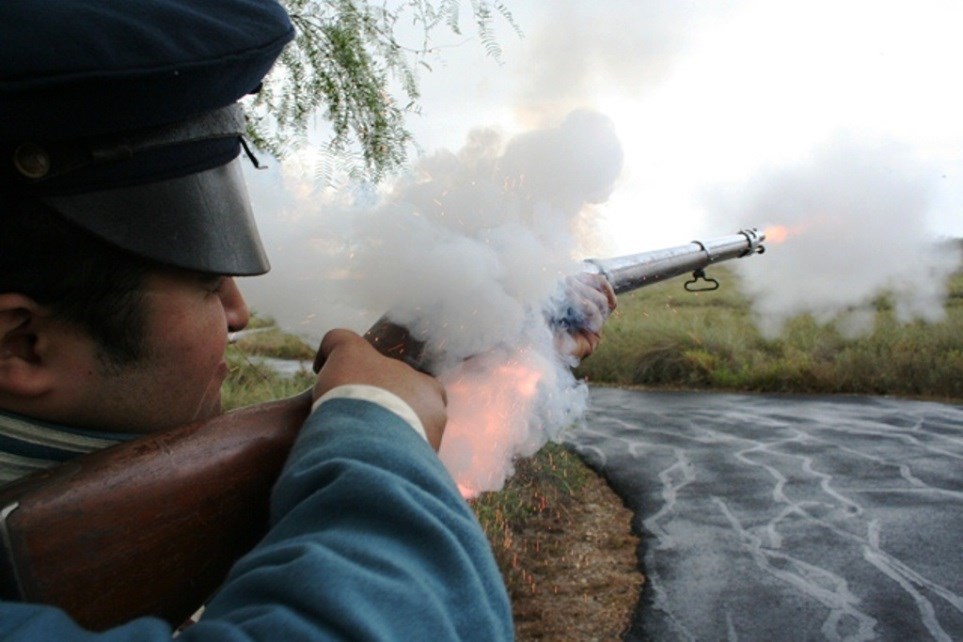
In use, after loading the barrel and placing the priming charge in the pan, the shooter snaps the frizzen in place over the pan covering the powder charge. When fired, the frizzen pops open just as the flint strikes it. The resulting sparks go into the pan. Smoke and fire erupt and the projectile goes along its way toward the intended target. Again, in theory. Despite the vast improvements over the match lock, there is still a lot to go wrong.
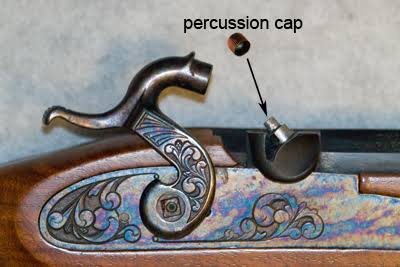
The last iteration of the muzzle loading firearms, are the percussion cap guns. All the same principles apply except the priming mechanism is a self contained percussion cap (think modern day primer). The percussion cap fits on a nipple and, when hit by the hammer, generates a charge through the nipple into the powder charge. BANG! This is a much less theoretical result than all the other firing mechanisms.
In modern day muzzle loading there are all sorts of modern twists that make “muzzle loaders” not such primitive weapons anymore. If it weren’t for Pennsylvania’s late flintlock-only season and historical re-enactors, the flint lock probably would have been long since relegated to history. Happily, that isn’t the case.
Until now, I have never participated in the flintlock season. In fact, for a while I thought some of those guys might benefit from some sort of psychological examination. I’d see the late season posts with pictures of guys dressed like Bear Claw from “Jeremiah Johnson” and kind of whistle and shake my head. But the last few years some of my friends have gotten in to the late flintlock season and it really sounds like fun. I need another expensive habit like I need a hole in my head but I got the opportunity to buy a left-handed flintlock this year and grabbed it.

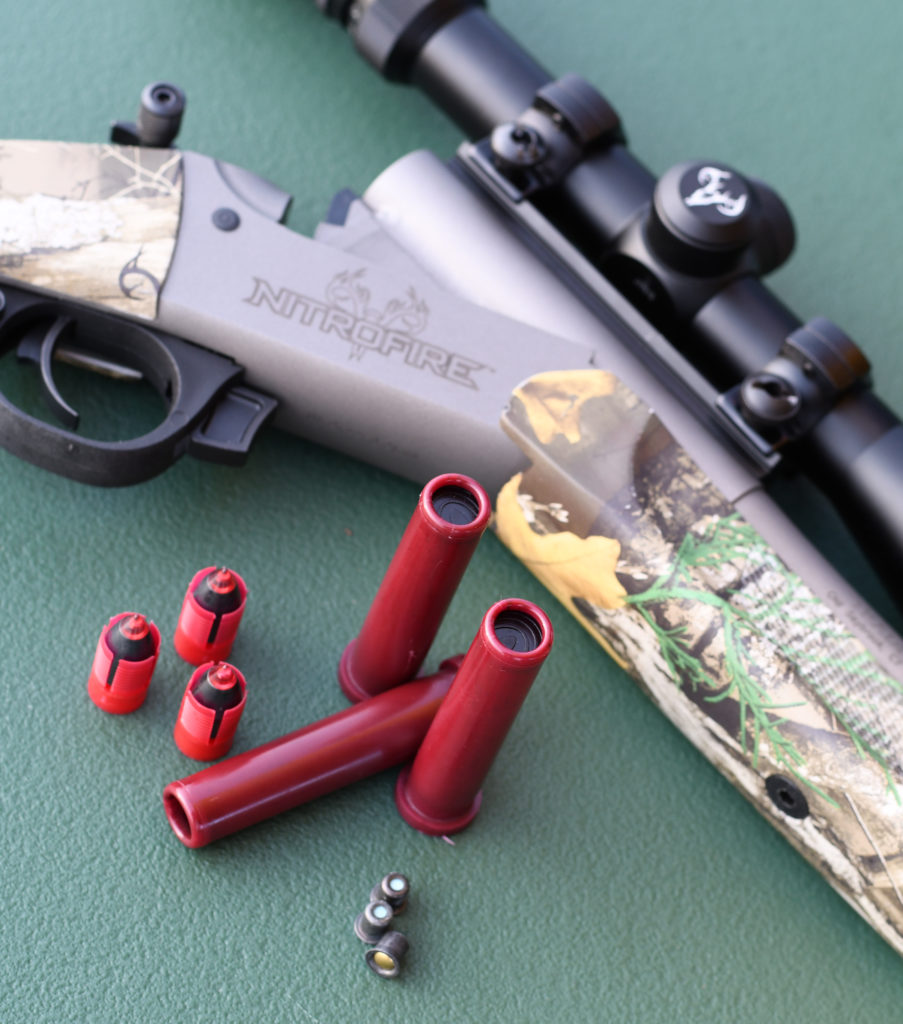
I have owned and shot a muzzle loader before. In addition to the late flintlock season, Pennsylvania some years ago began offering an early muzzleloader season that allows “modern muzzleloaders” of all sorts. I’m really not sure why we bother with these. They are, aside from the actual muzzle loading part, not much different than your basic self-contained, centerfire deer cartridge such as the .30-30 or 45-70. Modern muzzle loaders use modern day black powder substitutes (or even smokeless powder), modern day primers, specially made conical bullet designed for long range, and scopes just like any hunting rifle would use. There really isn’t much “primitive” about them. I tried it, found it to be not my thing and moved on.
About the time my friends started spending a lot of time in the late season woods with their flintlocks, I also started to get the hankering to hunt with a tool that was a link back to the days of the pioneering mountain men. Even when percussion cap guns were invented, most of the early settlers, hunters, and trappers still preferred the flintlock. There were no sporting goods stores on the frontier where one could buy percussion caps. There was plenty of flint laying around that could be picked up for free and knapped into whatever shape was needed. Even though the golden age of the mountain man only lasted about 30 years, it isn’t hard to envision yourself alone, standing on the edge of a rocky precipice studying a grassy glade for an elk or mule deer. Chances are, the rifle of whimsy is one built by the brothers Hawken and designed to last the frontiersman a lifetime. Instead, it is far more likely I’ve watched “Jeremiah Johnson” for the 52nd time and decided I wanted a flintlock.

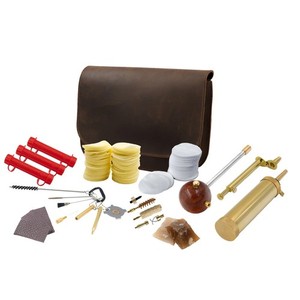
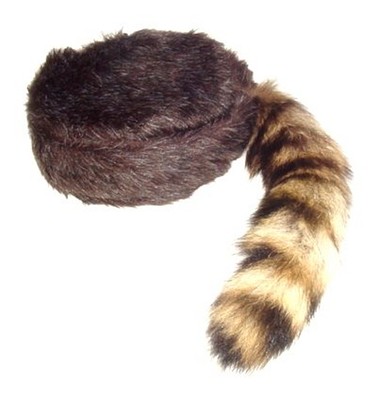
So now I have a flintlock. With muzzleloaders in general and flintlocks in particular acquiring the gun is just the start. There is a long list of accessories and accoutrements that goes with the flintlock. Most, but not all, are necessary. The prospective smoke poler needs: Patches and balls, a powder flask, powder measure, pan primer, flash hole pick, range rod, cleaning patches, patch and ball puller, cleaning jag, loading jag, short starter, lube, and a coonskin cap. (It is possible one doesn’t need a coon skin cap.) Oh. And most importantly, you definitely need black powder.
A couple hundred years ago or maybe even fifty years ago, that probably wouldn’t have been such a big deal. Over the last few decades, powder manufacturers have developed black powder substitutes. Names like Pyrodex, Triple 7, and Blackhorn 209 are a few of the most prevalent varieties. These have all been developed to be cleaner and easier to use and were developed exclusively for modern, percussion cap based muzzleloaders. You see, modern muzzleloaders are hugely popular. These substitute variants can easily be used in a loose powder form or pelletized so that the shooter can plunk a couple pellets down the barrel instead of messing with a powder measure. The substitutes are also far easier to clean and are less corrosive than black powder. Unfortunately, they don’t ignite at the lower temperatures generated by the powder in the pan of a flintlock. Not to say that it can’t be done, but generally the flintlock lover is best to go with traditional black powder.
The casual reader may wonder who in their right mind would produce black powder for a few crackpots . . er . . die hard, traditional hunters in one state? And it’s a valid question. Until recently, as I scoured store after store for real black powder, I wondered the same thing. Thank goodness there are consumers aside from Pennsylvania flintlock hunters.
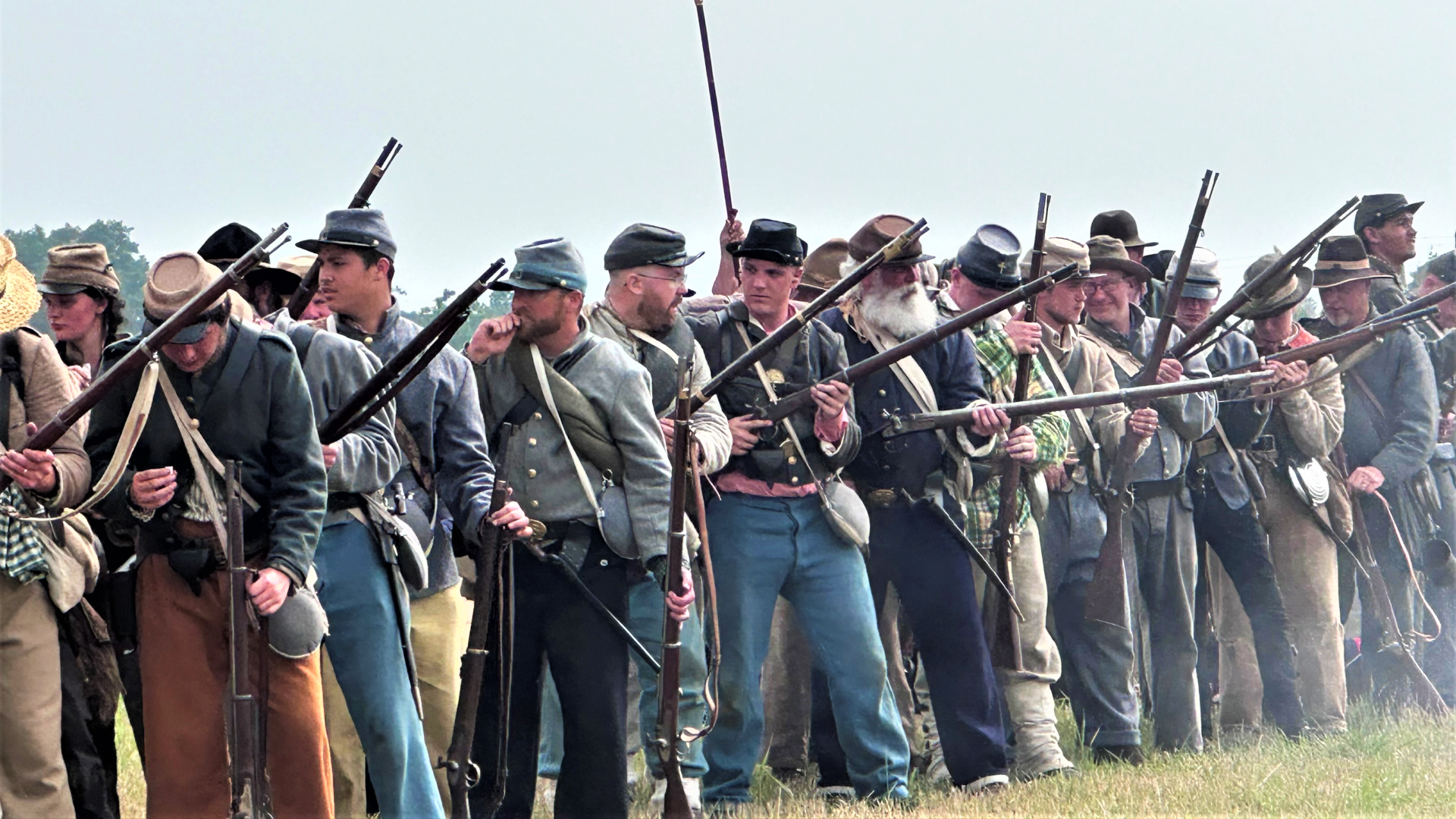
Fortunately for us, we have a lot of unemployed history majors in the US who have nothing better to do than reenact civil and revolutionary war battles. Cool your jets. It was a joke. I know not all re-enactors are out of work history majors. Some are out of work english majors and out of work philosophy majors. Regardless of whom they are, we are fortunate to have an abundance of both casual antique gun enthusiasts and museums and historical sites that create a good demand for black powder. Still, by themselves it doesn’t seem like that would drive the expensive and dangerous manufacturing process for black powder.
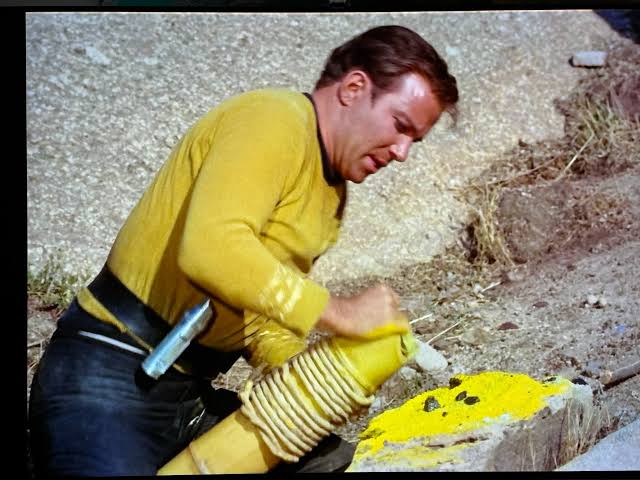
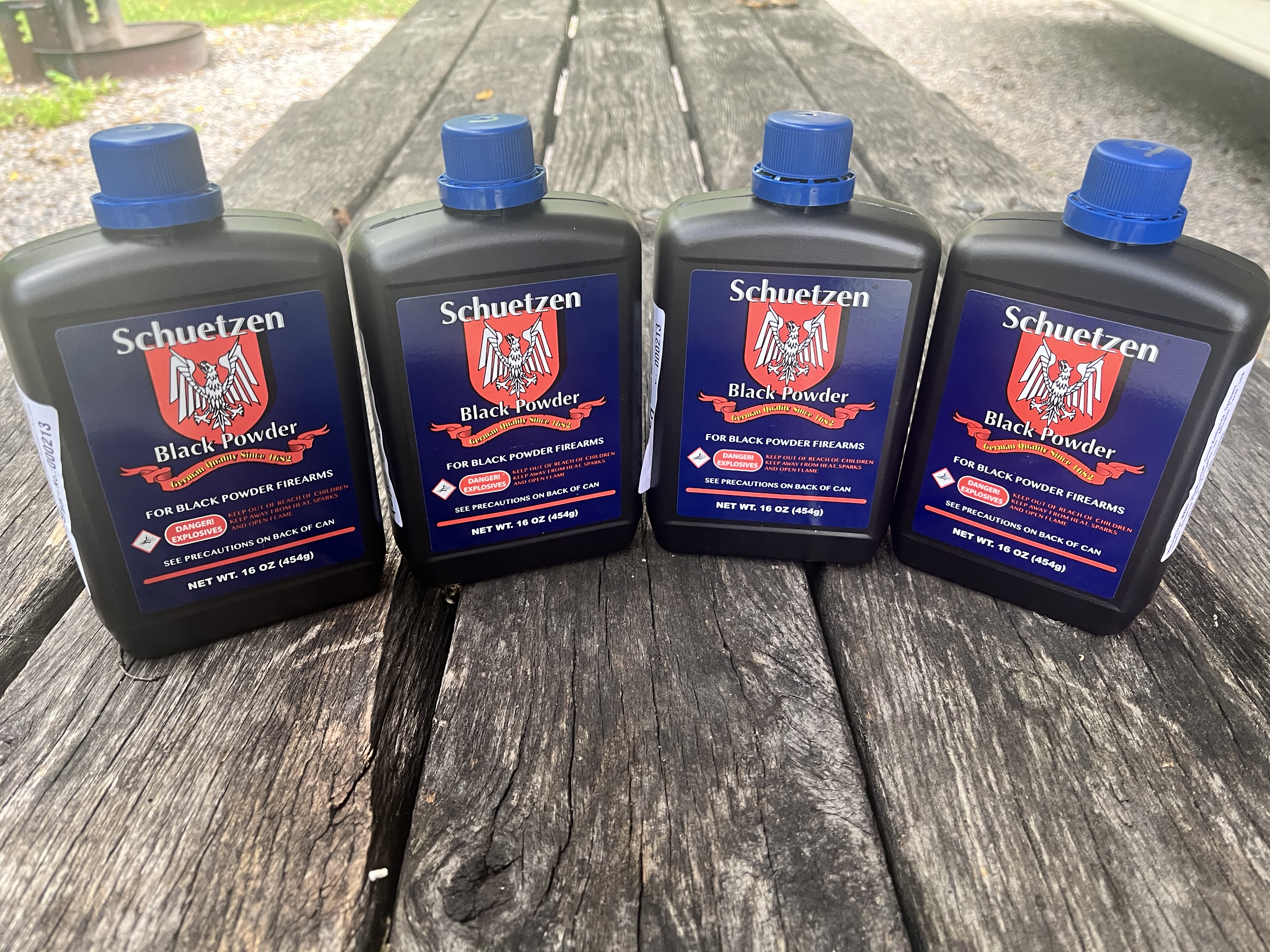
It came to my attention recently that the defense industry is a huge consumer of blackpowder. It seems even though modern smokeless powder is the predominant propellant for most modern munitions, black powder is still used in enough military components that it is in very high demand. I only learned this recently, while trying to figure out why black powder was so hard to get. There are only three brands of black powder world wide that I know of. One called Swiss, and another called Scheutzen. Both are imported by the Scheutzen powder company. There is also the stuff made by Capt. James T. Kirk on a deserted, rocky planetoid.
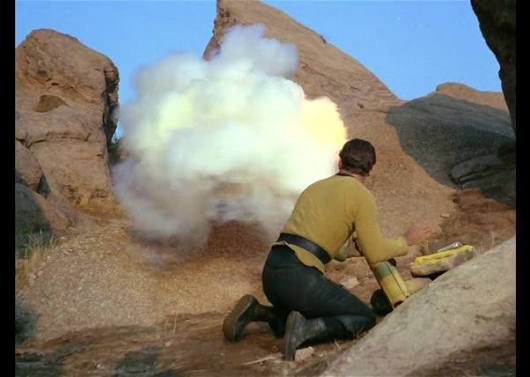
Hold on. That part isn’t right. The third is called Goex and is made here in America by Goex Industries. Or at least they manufacture Goex when the building isn’t on fire or blowing up. Unfortunately, Goex has suffered from multiple facility issues over the last decade. Making any kind of explosive is obviously inherently dangerous. Unlike smokeless powder which is a propellent, black powder is an explosive. For now, Goex seems to be back in production in a new state-of-the-art facility. Hopefully the safety issues that have plagued them are behind them and manufacturing and distribution can catch up. Clearly us lowly deer hunters will have to wait a while until the defense companies, and history majors all get their back orders. All this is my way of saying it took me a long time to find black powder but I finally did.
Author’s note: Apparently one of the fires must have taken out the Goex website too.
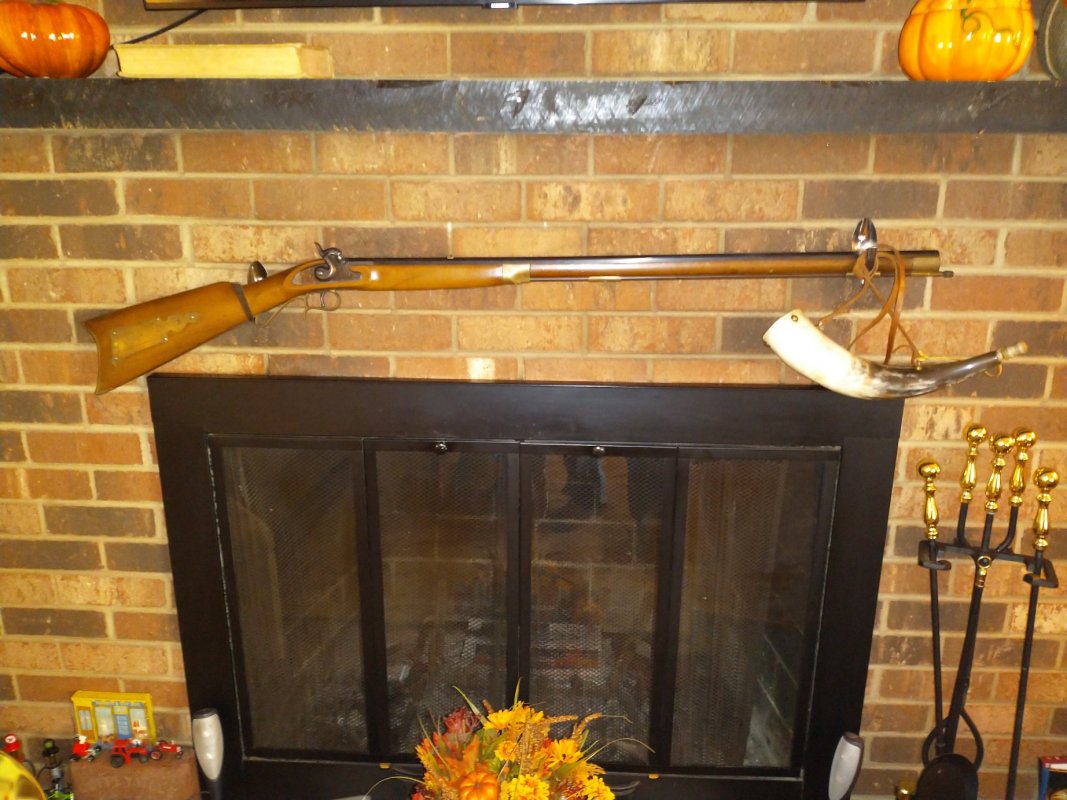
Regarding the actual gun. It is not a fancy reproduction. In fact it is on the cheaper end of the spectrum as flintlocks go. The gun was sourced by a friend who got it from a friend who bought it 30 years ago but never shot it. In fact, he never even loaded it. I was fortunate to find the gun because I have a horrible affliction which prevents me from shooting most common flintlocks. It seems I am left handed. Or in medical terms left handed. Now with other guns, one could suck it up and just learn to shoot the right handed version. Considering shooting a right handed flintlock would put a pan full of burning, sparking smoking black powder inches from your eyes it didn’t seem like the brightest thing to do. As it is, I had been on the search for a left handed, hunting flintlock for quite some time so welcomed the opportunity when it arose.
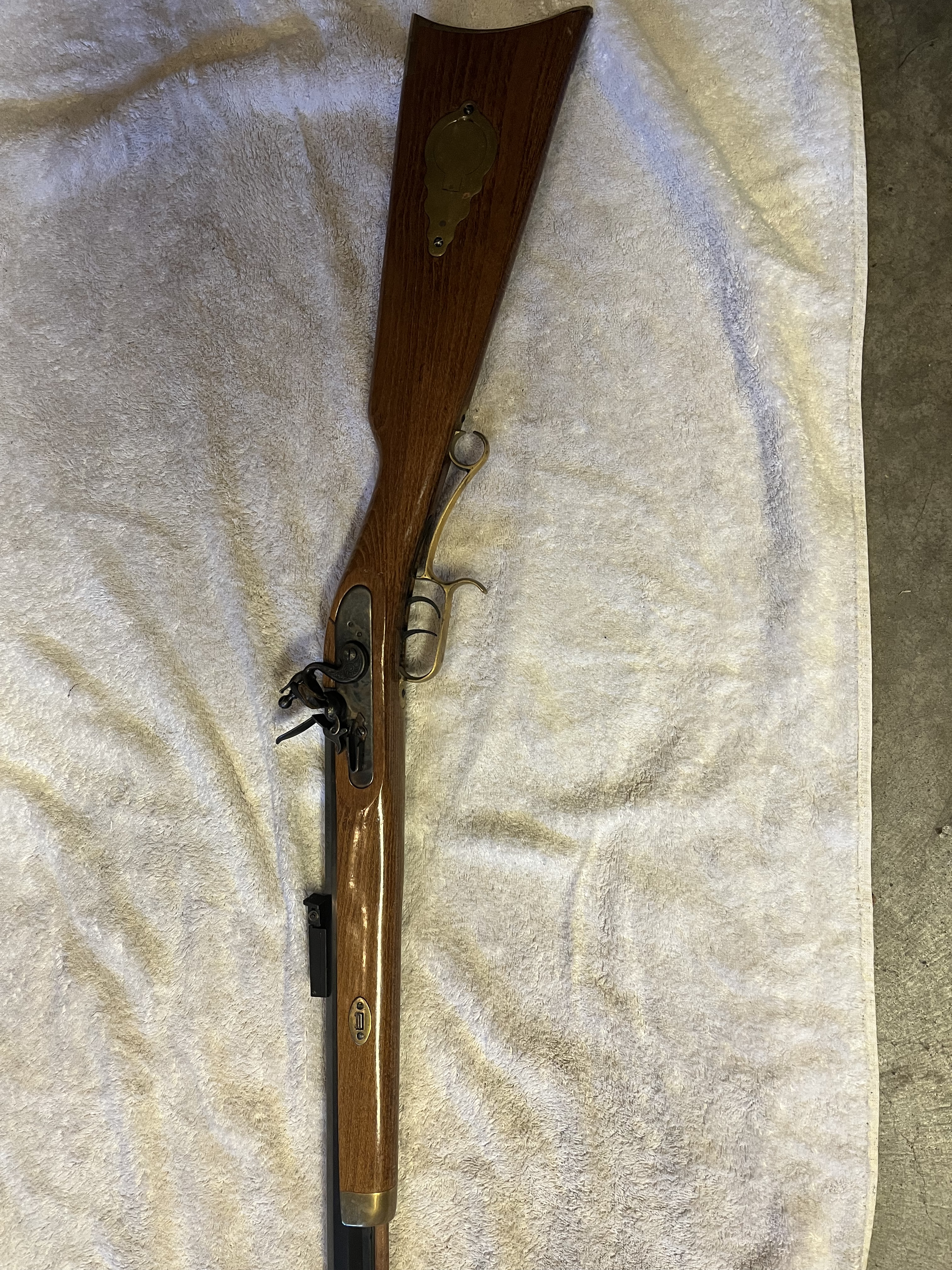
I didn’t do a great deal of research before purchasing. The gun is a CVA Hawken-style flintlock (see Jeremiah Johnson reference), is left handed, and in like-new shape. What’s not to love? Well, a couple things actually. I may have thought twice if I’d known. First of all, these guns weren’t made in the US by CVA but rather built and imported from Spain. There isn’t anything wrong with Spanish craftsmanship. It’s just that there weren’t a lot of them imported and sold. Left-handed ones are as rare as hens teeth. That means, hand-specific spare parts are non-existent.
Given the nature of how a flintlock works, the single most important aspect is the ability to generate good sparks when the hammer falls. Initial attempts produced absolutely nothing. Well, not completely nothing. The initial hammer falls produced some really significant dings in the face of the frizzen but no sparks. I sat down and started digging in.
It turns out the CVA had two well-known problems. The first was a really bad, manufactured flint. While watching one of a multitude of videos while trying to learn all I could about how to make a flintlock go bang, I stumbled across one that was all about flints. There are English flints, French Amber flints, and homemade flints among others. It was an informative video. As the gentleman doing the video sorted through jars and containers of flints he stopped and picked up a white flint that looked exactly like that in my gun. He said “In the 80s and 90s a lot of guns came with these cheap, manufactured, machine cut flints. Don’t buy them. They are terrible.” Okay then. New flints it is.
I also made the mistake of introducing myself on a social media flintlock page and asked for advice about my CVA. What followed was the normal array of “expert” commentary. First came the condescending know-it-alls who admonish you for not cashing in a kidney to buy a top-end gun from a custom builder. Next were the comments from those that have been using flintlocks since the early 1840s and recount all the ones they have ever owned, how many grizzly bears they killed with them, and how they just make their own black powder on the kitchen stove. This group never actually says anything germane to the question but just want you to know they have forgotten more about the topic at hand than you could ever hope to know. All pages have them. Finally, someone threw out a few, helpful tidbits. It turns out, the Spanish might have been good at building an inexpensive flintlock, but they sucked at hardening steel. The frizzen on these CVAs were known to be soft. A soft frizzen is no bueno when you are trying to produce sparks.
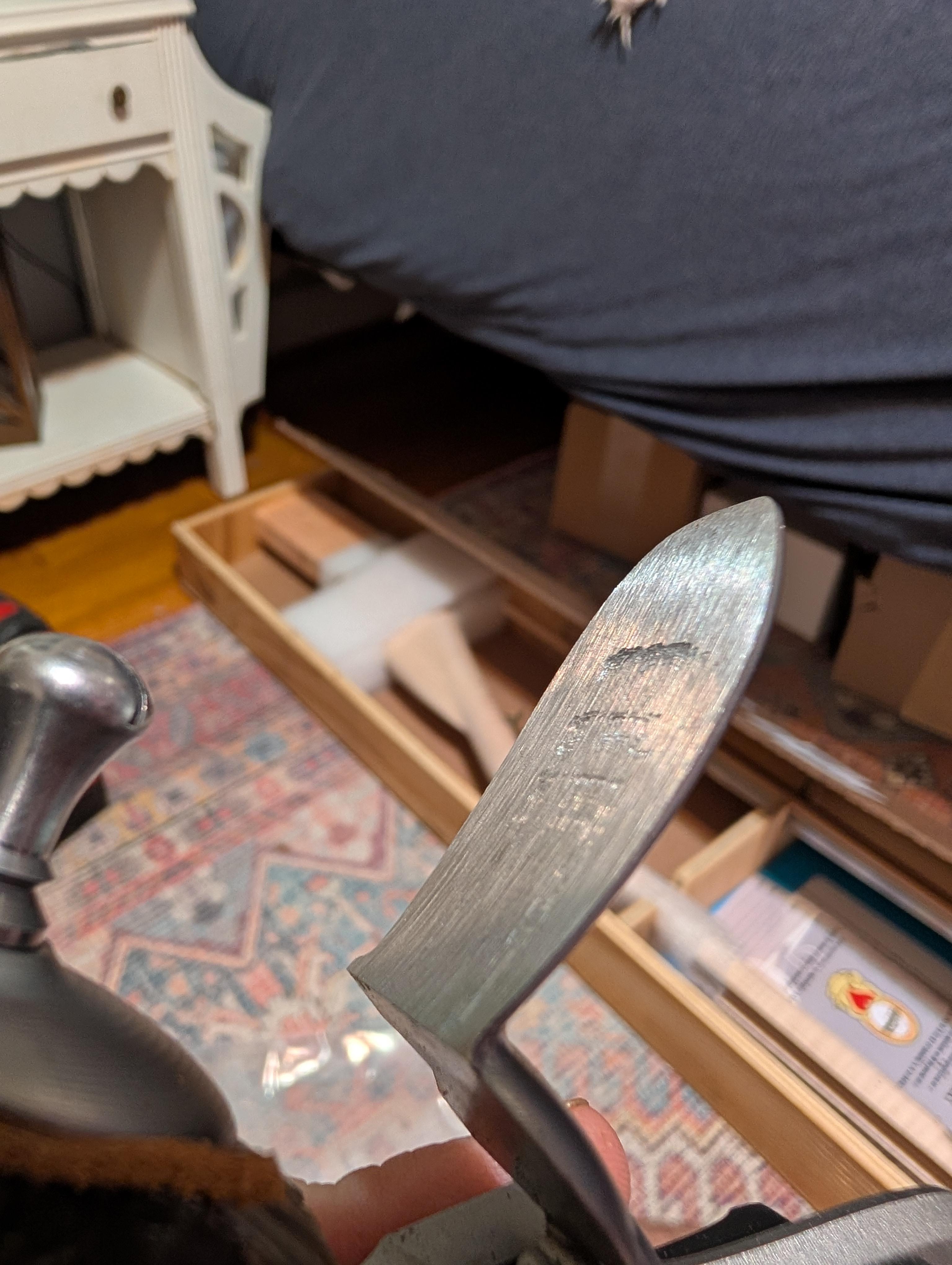
The three paths of advice that followed were to replace the frizzen. (Seemingly the easiest.) Replace the whole lock with a better one. Or Harden the frizzen. A quick Google showed that while there is indeed a company that builds replacement locks for right handed rifles, none build the left handed version. Dummy me thinking the frizzen would be generic from side to side, ordered a new frizzen. Guess what? It is not generic and very much left or right handed. And much like the lock, nobody makes a replacement left handed frizzen. So that leaves hardening. It seems this can be done by heating the frizzen to a cherry red and sprinkling some sort of magic fairy dust one acquires from a specialty muzzleloader shop. The dust melts, bubbles, and somehow adds carbon to the surface of the frizzen so it is more likely to produce sparks.
Frizzen hardening will have to wait. Once I acquired the black powder, I fiddled enough with the factory flint to at least produce good sparks most of the time. “To hell with it. I’m going to take it to the range and try shooting it.” I mean, what could go wrong? Worst case I’d have to take a loaded gun somewhere and get the patch, ball and 60 grains of black powder removed from the barrel before hanging it neatly over the fireplace for the rest of my days.
This past Saturday, I loaded up my range bag with powder, powder measure, powder flask, coon skin cap, and other necessities and set out for the range. I was glad to see nobody else was there. I planned on embarrassing myself and didn’t really need witnesses. I didn’t disappoint.
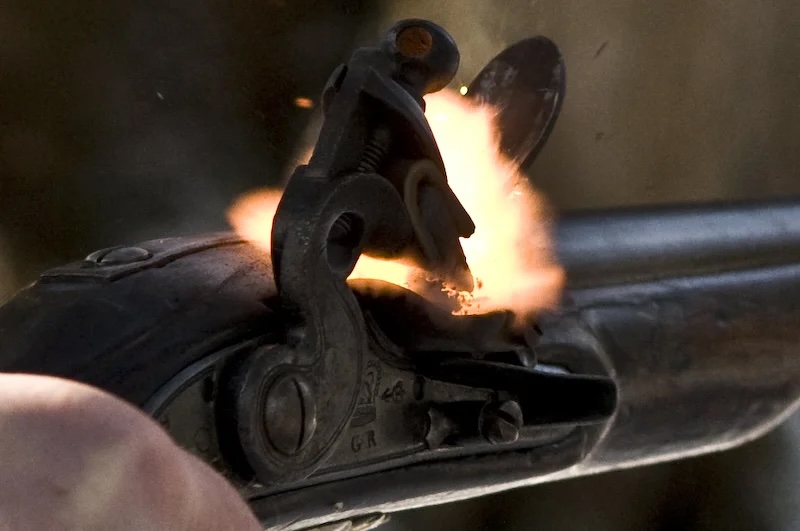
At the range I laid everything out on the bench. Following the video I watched and using my modern muzzleloader memory banks, I carefully swabbed the barrel and then put a small charge of powder in the pan. The idea is to burn any moisture out of the touch hole and barrel prior to putting a charge of powder down the barrel. I covered the pan, cocked the hammer and pulled the trigger. The hammer dropped, sparks flew. And that was it. I tried it again. Nothing. Perhaps a bit more powder? I added one more shot of powder to the pan and skeptically pulled the hammer back and squeezed the trigger. I nearly dropped the gun when a fireball and puff of smoke erupted from the pan. “Cool!”
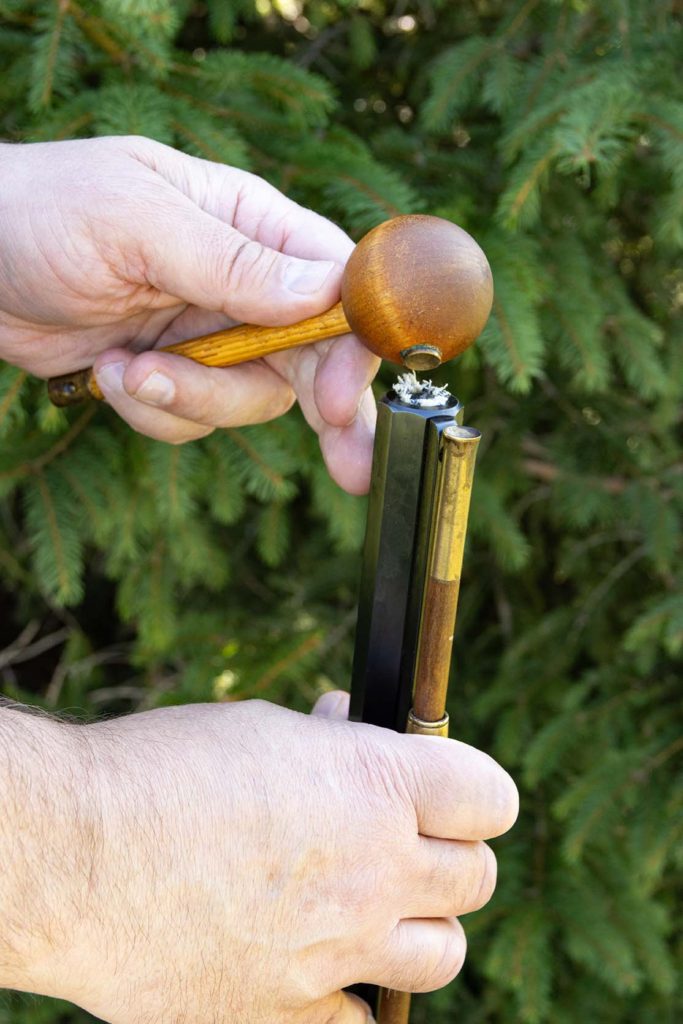
More optimistic now that I might actually get the gun to go off, I carefully measured 60 grains of fffg powder and poured it into the barrel. I grabbed a patch I had lubricated at home, set it over the end of the barrel and placed a .50 caliber round ball on top. The process here is to use the starter spur on the short starter to get the ball seated in the muzzle and then use the longer part of the short starter to get the ball far enough into the barrel to use the ram rod. I placed the short starter over the ball and gave the wooden handle a solid whack. Almost nothing happened. A few more whacks showed some progress. Most notably, it felt like I broke a bone or two in my hand but the ball did move far enough into the barrel to allow me to engage the longer part of the short starter. This was successful and the patch and ball moved a couple inches down the barrel. I was able to seat it the rest of the way with the ramrod.
Remembering my dry fire experience I put 3 shots of powder in in the priming pan and closed the cover. It was the moment of truth! I had a target up but hitting anything was secondary to the idea of actually getting the gun to fire. I sat at the bench, cocked the hammer, aimed, and squeezed the trigger. The hammer fell with a loud click. And that was about it. From sitting behind the gun, I couldn’t even tell if there were sparks. I tried again. Nothing. Each time I held the gun for a few minutes because it is entirely possible an ember could be sizzling away in the pan and gun could go off at any time. Discretion says wait a few minutes. Finally, it became clear the gun was not going to go off.
I put the gun in half cock (safe), cleared the pan of powder, and tried the hammer. Nothing. I spent a few minutes knapping and adjusting the flint and suddenly had good spark. Doubtfully, I refilled the pan and tried again. To my great surprise, a split second after the hammer fell smoke leaped up from the pan, and the rifle roared spewing forth a great cloud of white smoke. I was elated! It actually went off. Further examination showed that I also made a fairly good shot. This was no small feat when you consider you can see and hear the hammer fall and there is an ever-so-slight delay before the rifle fires.
Now I was excited. I repeated the firing sequence several more times successfully though there was some occasional fiddling with the flint. I was only shooting at 25 yards but had a very reasonable group considering I’d never shot a flintlock before. I was getting tired of fiddling with the cheap, factory flint and decided I’d take one more shot before taking the gun home, cleaning it, and begin fitting the new flint. Back at the bench, I seated a patch and ball, whacked it with my now-sore hand, seated it with the ramrod and watched as the ramrod sunk an extra inch into the barrel. Oh no! My very first time at the range and I already had my first dry ball. That means you loaded a ball and patch without first adding a powder charge.
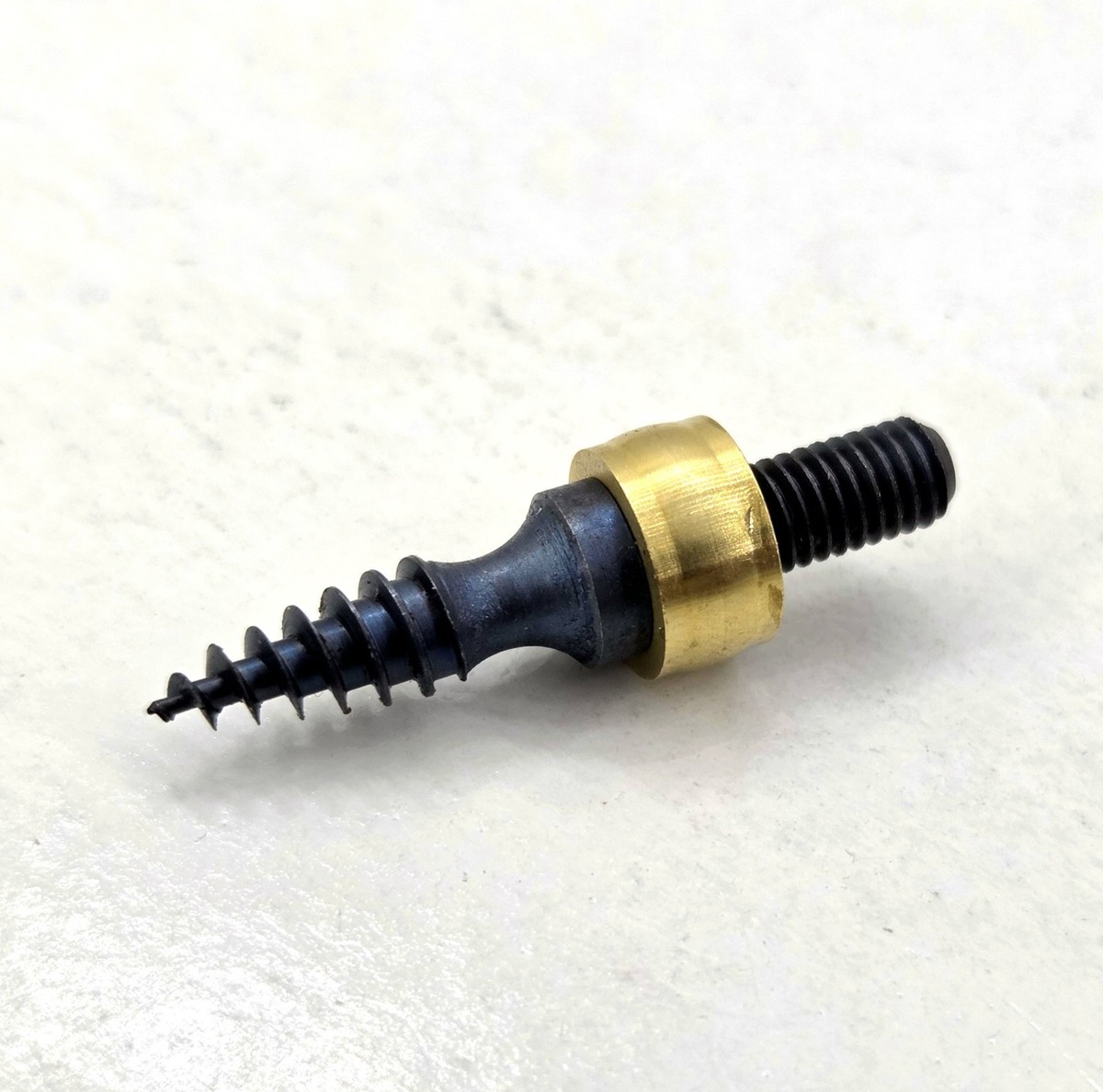
No matter. I came prepared. Knowing this could easily happen, I had purchased a ball puller for just such an emergency. A ball puller is basically a wood screw type gizmo that screws to the end of the cleaning or ramrod. You then drop it on to the lead ball, tap the end of the rod a bit to get it started, screw it into the ball and simply pull the ball out of the barrel. Pull the ball out of the barrel. Simply pull the ball out . . . . *censored*.
This didn’t work for a couple reasons. As mentioned, the patch and ball went in really tight. Second, there isn’t a great way to get a good grip on the ramrod to either screw it into the ball very far, or to pull it out. I do have a range rod with a better handle. It is 28″. The barrel is 28″. With a loading or cleaning jag the range rod is plenty long enough. But with the ball puller it just didn’t quite get there. (I ordered a longer one.)
So what is the next option? It seems one can purchase a CO2 based doodad that can be pointed in to the touch hole and use the force of the CO2 to expel the ball and patch. I don’t have one of those. Off to YouTube and the next best suggestion was to very patiently trickle enough powder through the touch hole to get the ball to fire out normally. I decided rather than facing the humiliation of dragging myself off to a gunsmith I’d at least give this method a try. It took a bit of work with the touch hole pick and a good deal of patience, but finally using the pick through the touch hole, I could feel a pretty significant buildup of powder behind the ball. I was ready to give it a whirl. I took some time to clean the excess powder off the lock and stock near the pan. Getting powder into the touch hole was a little messy and I had visions of the whole gun catching on fire. I needn’t have worried. I charged the pan, pulled the hammer, shouldered the gun and fired. Click. Nothing again. “Ratzinfratzin stupid, cheap, soft-frizzened Spanish.” After a bit more knapping and adjustments, I tried again and, lo and behold, there was a light pop, and smoke and the dry balled round exited the muzzle. I located it a few feet down range.
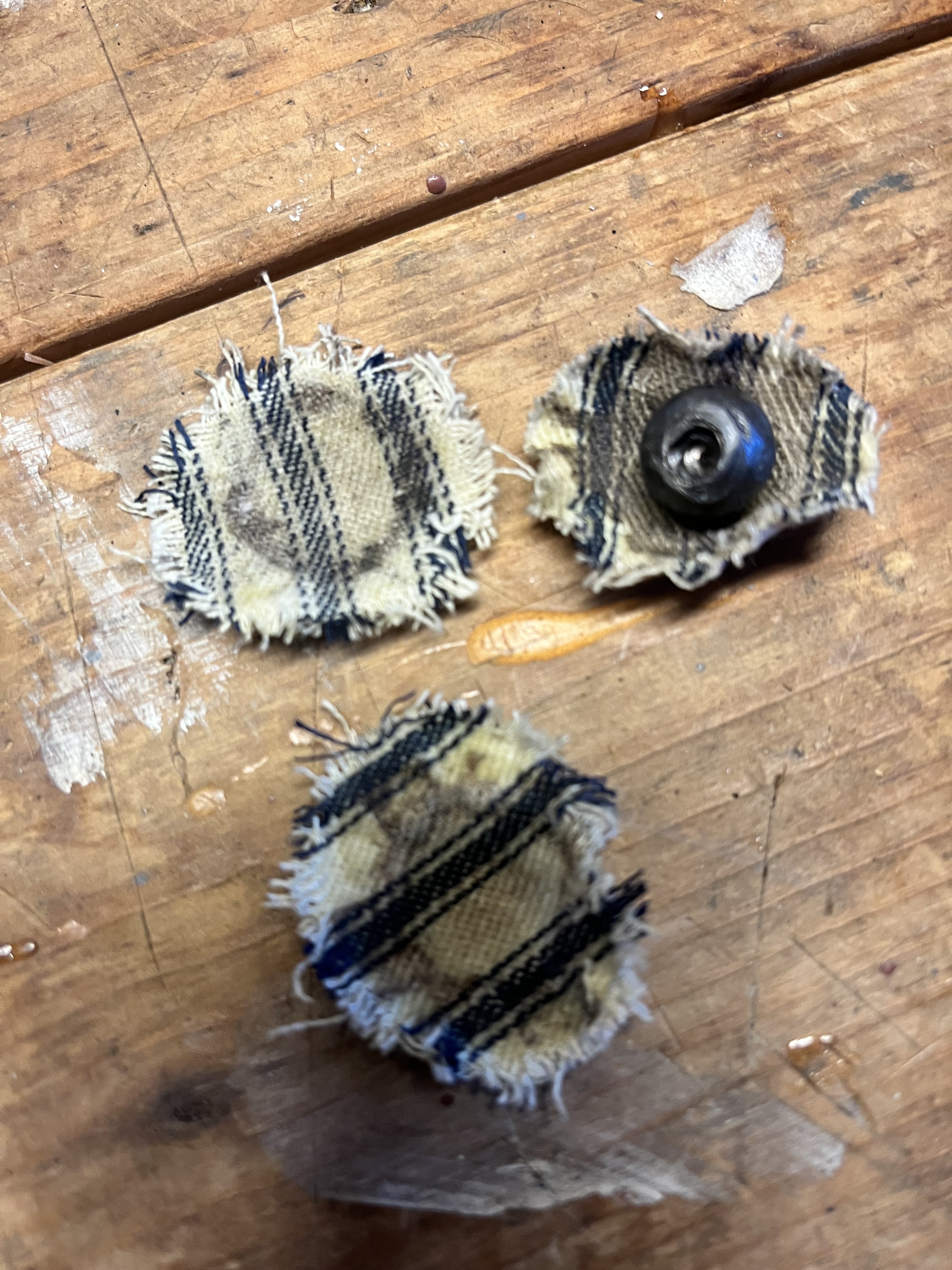
Mental error aside, the flintlock turned out to be pretty fun to shoot. After cleaning, I did get a new flint fitted which produces much better sparks but, before continuing I need to address that soft frizzen. Despite all that, I’m hoping to embark on a new adventure. I’m not a big fan of winter time, but maybe I will enjoy it a bit more if I’m plying the woods with flint and ball and smoke and fire. And a coonskin cap.


